
21M max supply
The software sets a hard cap: about 21 million bitcoin, ever. That number is not a committee decision.

Featured research and frameworks. Longer pieces live here; the daily reads are on X.
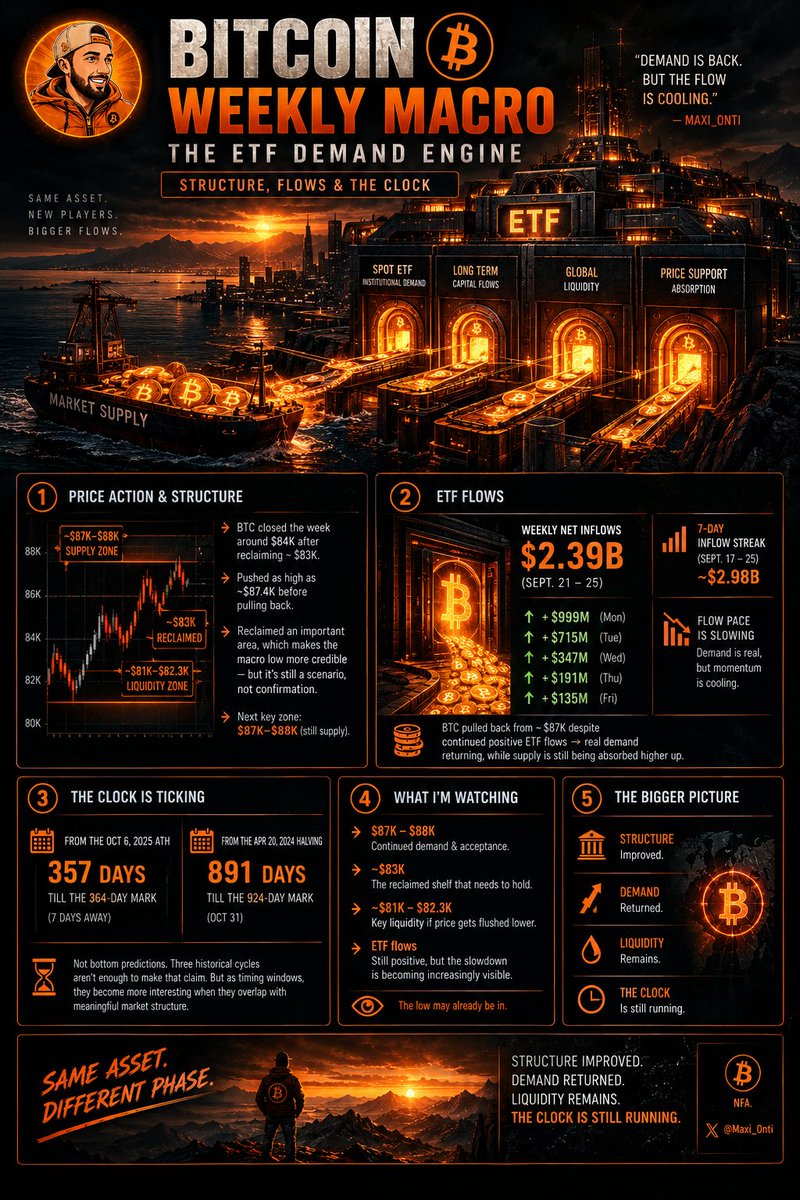
Week closed near $84k after reclaiming ~$83k. ETF inflows still positive but cooling. $83k is the shelf.
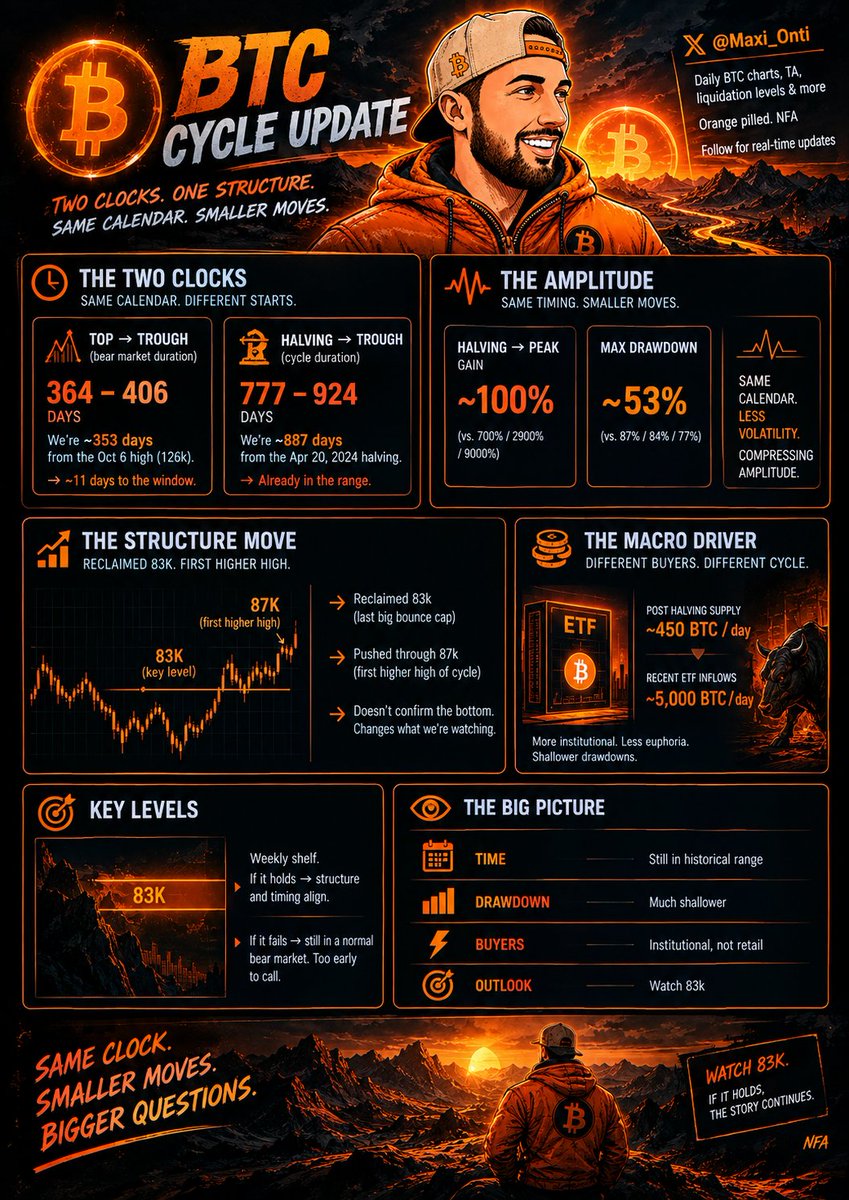
The point was the $83k weekly shelf, not one folklore date.
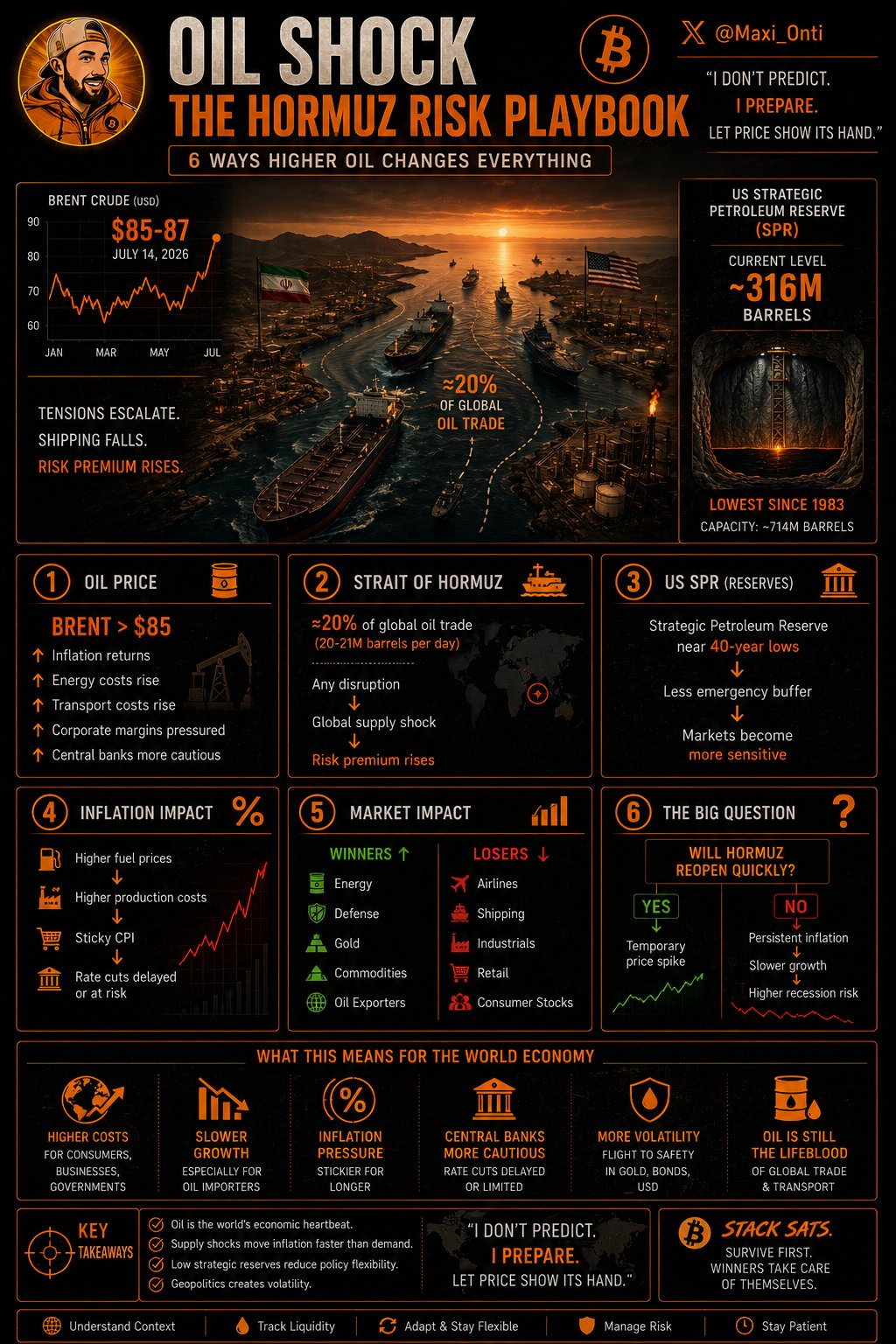
A Hormuz shock is a Bitcoin input, not just an oil headline. The SPR buffer is thin.
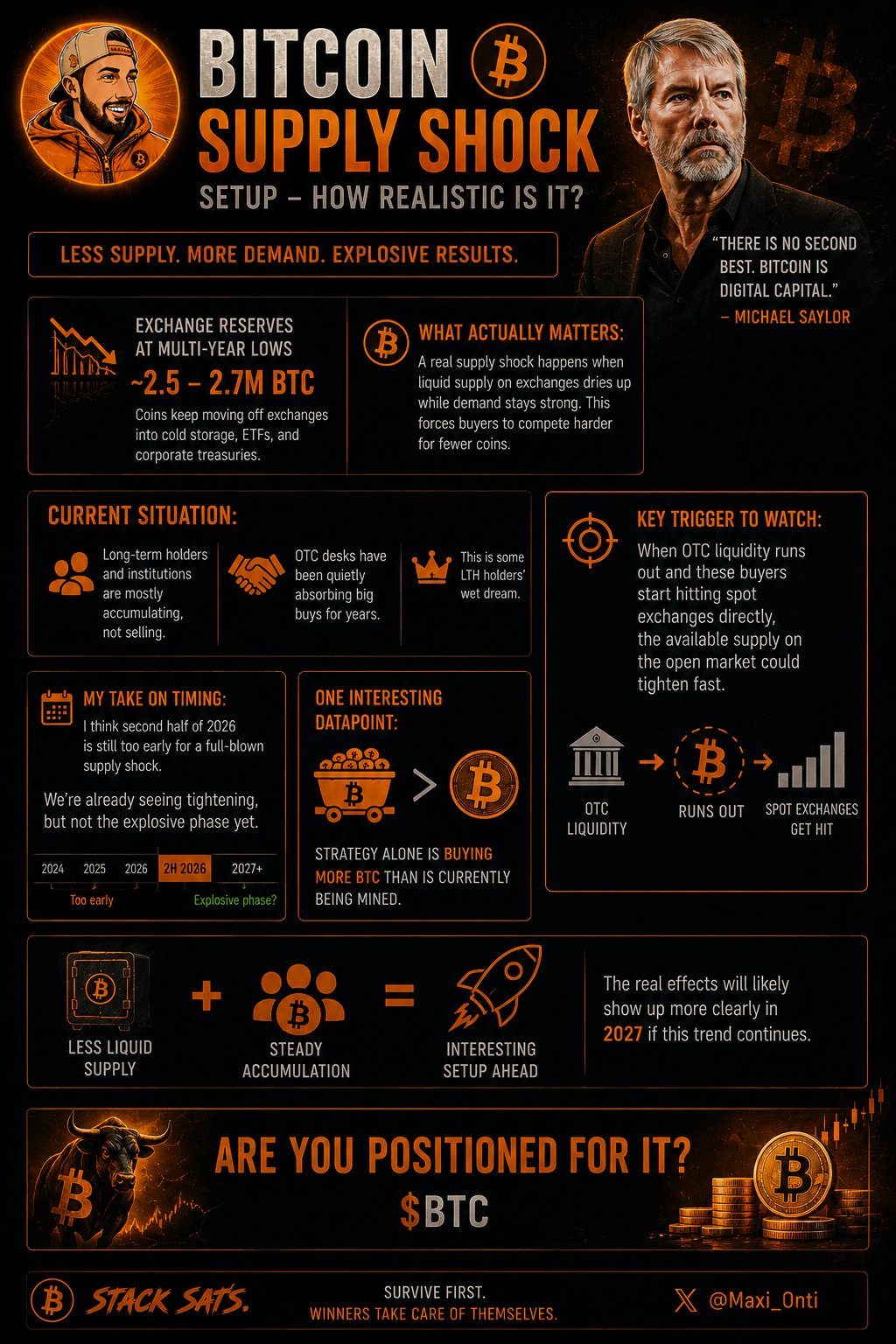
Tightening is real. Calling the timing is the trap — a full squeeze still looks more 2027.
The cap, in one page
Who holds the bitcoin?The fixed cap, who holds the coins, and how much is actually free to trade.
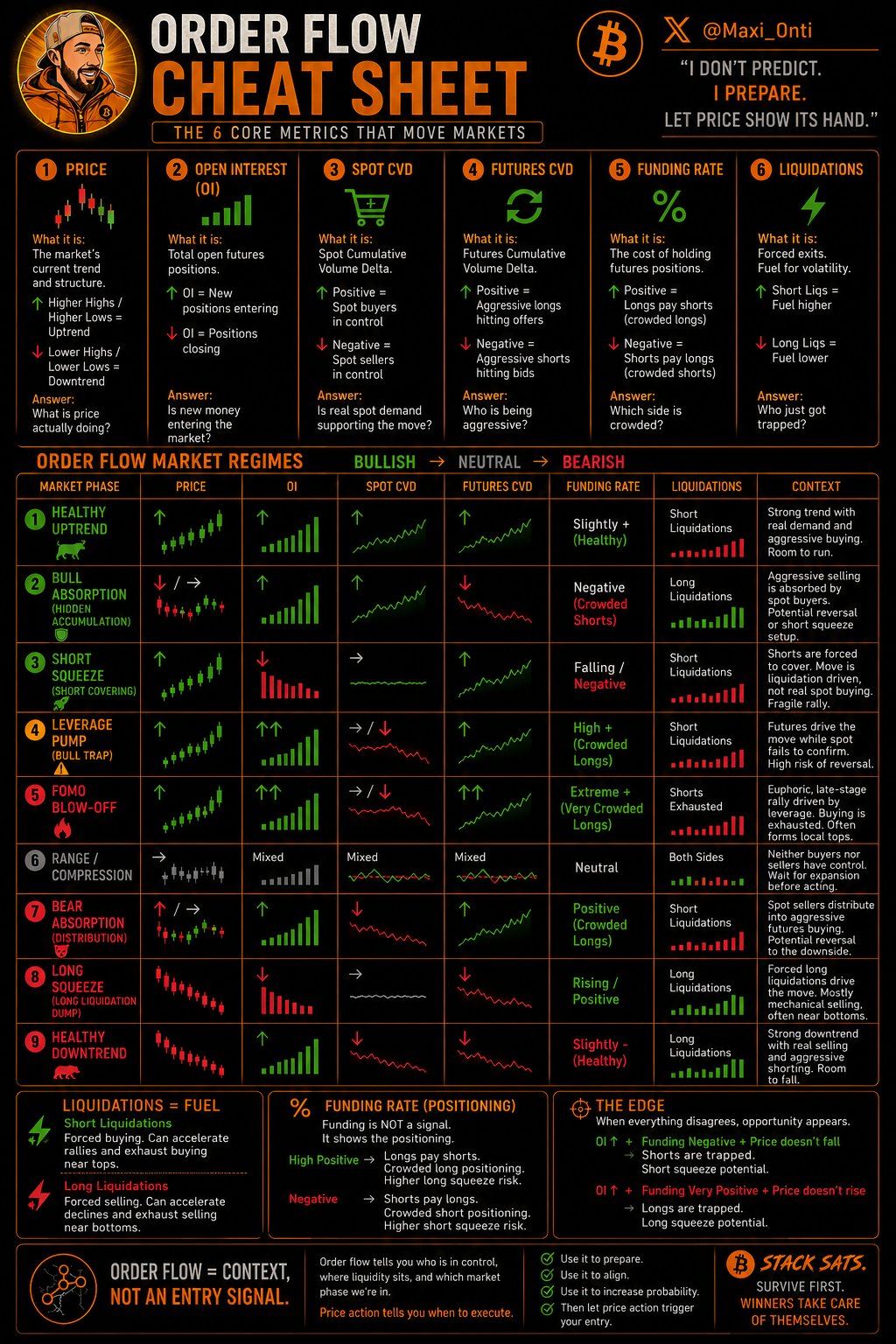
Six things move the tape. Nine phases show who’s in control.
Loading.
Personal positioning only. Not a signal.
 Supply
A decentralized monetary network. A scarce digital asset. And one of the most interesting markets in the world.
Bitcoin started as an attempt to create digital money without a central authority. Today the rules are the same, but the market around them is not. ETFs, banks, and governments are buying an asset that was built to cut out the middlemen. This page starts with the plain system, then shows where that story stops matching the price.
Inside: basics, how it works, scarcity, liquidity, gold vs fiat, myths, Bitcoin today, how to participate, and my take.
What makes it different?
Before going deeper, understand the properties that make Bitcoin different.
The software sets a hard cap: about 21 million bitcoin, ever. That number is not a committee decision.
No single institution runs the network. That can still be true even as big firms hold, custody, and trade more of the coins.
You do not need a bank’s approval to use the network. Anyone with an internet connection can send or receive.
A transfer does not have to pass through a correspondent-bank chain. The network does not care which country you are in.
The history of payments is public. You can check it yourself instead of taking a ledger-keeper’s word.
New coins appear on a published schedule — Bitcoin’s monetary policy. No one votes to print extra outside those rules.
Trading does not stop for weekends or holidays. The market is always open.
You can hold the secret (a private key) that proves those coins are yours — instead of leaving them with a bank or exchange.
Bitcoin is ultimately a system of rules: who can move BTC, how transactions are validated, and how new BTC enters circulation.
Why does it exist?
In 2008, Satoshi Nakamoto proposed a peer-to-peer electronic cash system that could operate without relying on a central financial intermediary.
Can people transfer value over the internet without needing a bank or another trusted third party to approve every transaction?
Instead of relying on one institution to maintain the ledger, Bitcoin uses a distributed network following common rules.
Bitcoin’s breakthrough was not simply sending digital information. It was creating a system for transferring scarce digital value without a central ledger keeper.
How does the system move value?
Not six boxes Bitcoin “lives in.” Six steps a payment typically travels through, from a signed instruction to a shared ledger the network agrees on.
You create a payment instruction and sign it with a private key — a secret that proves you control those coins. There is no “forgot password.”
That signed instruction is broadcast to computers running Bitcoin software around the world.
Those computers check the rules: are the coins real, and have they already been spent? Invalid payments are ignored.
Miners compete in proof-of-work: a costly computational race. The winner proposes the next batch of payments as a block. The cost makes rewriting history expensive.
A block is a timestamped batch of transactions. The blockchain is those batches chained together — a public record anyone can download and audit.
Consensus is how the network agrees which history is valid without a referee. Follow the rules, and you stay on the same ledger as everyone else.
No single institution controls Bitcoin’s ledger or can simply decide to create more bitcoin outside the protocol’s rules.
What is the monetary property?
Bitcoin’s most important monetary property may be its scarcity.
Bitcoin’s supply is constrained by its protocol. New BTC enters circulation according to a predetermined issuance schedule, with the maximum supply designed to be approximately 21 million BTC.
Has a fixed supply. The ceiling is in the protocol.
Do not have a fixed supply ceiling.
BTC doesn’t have a protocol-defined dollar floor.
When you price Bitcoin in USD, you’re not only measuring Bitcoin. You’re measuring Bitcoin against the dollar.
Bitcoin can fall dramatically in dollar terms. There is obviously no guarantee that BTC cannot go lower. But there is no fixed USD value embedded in Bitcoin’s protocol. The denominator matters too.
If the supply of dollars and dollar-denominated liquidity changes over time, the value of scarce assets measured in those dollars can change as well. That’s one reason I don’t look at Bitcoin in isolation.
As of 5 Oct 2026
Who holds the bitcoin?Mined supply, ETFs, company treasuries, governments, and which coins actually sit still. The categories overlap. The page says where.
How does the money supply connect?
M2 is a broad measure of money in the economy. It includes physical currency and various forms of relatively liquid deposits.
When money and liquidity expand, there can be more capital available to flow through financial markets and into assets. Bitcoin is particularly interesting in this environment because its supply cannot simply expand to meet additional demand.
M2 growth does not automatically mean Bitcoin goes up. Consumer-price inflation is also not simply the same thing as M2 growth. Inflation depends on multiple factors including money creation, credit, velocity, economic output, fiscal conditions and demand.
The relationship is better understood as a macro liquidity framework, not a simple trading signal.
Correlation is not causation. Bitcoin can diverge from liquidity for long periods.
How does it compare?
| Bitcoin | Gold | Fiat / USD | |
|---|---|---|---|
| Supply | Approximately 21M maximum | Naturally scarce, but new supply can be mined | No fixed supply ceiling |
| Issuance | Predetermined protocol rules | Physical extraction | Monetary policy |
| Central issuer | No central issuer | No central issuer | Central monetary authority |
| Portability | Extremely high | Low at large scale | High digitally |
| Divisibility | Extremely divisible | Limited physically | Highly divisible |
| 24/7 transfer | Yes | No | Depends on financial infrastructure |
| Self-custody | Yes | Yes | Generally held through financial institutions |
| Supply transparency | Publicly auditable | Estimated | Policy and monetary data are publicly reported |
| Censorship resistance | High with proper self-custody | Physical possession provides resistance | Strongly dependent on financial institutions and legal systems |
| Historical track record | Relatively young | Thousands of years | Long but historically varied |
| Volatility | Very high | Historically lower | Low nominal volatility against itself |
| Monetary policy | Protocol / network consensus | Natural supply constraints | Government / central-bank policy |
Bitcoin sits somewhere between gold and a new type of monetary infrastructure. Like gold, scarcity is central to its value proposition. Like fiat, it can exist entirely digitally. But unlike both, its monetary rules are enforced by a global network rather than by a government or physical scarcity alone.
What do people get wrong?
These are the stories that sound true until you look at how the system actually works.
Not exactly. Your BTC isn’t literally sitting inside your wallet. The Bitcoin blockchain keeps track of the Bitcoin associated with addresses and the conditions required to spend it. Your wallet primarily manages the private keys that allow you to authorize transactions.
The BTC record.
The keys.
The BTC stays on the blockchain. Your keys give you control over it.
Not necessarily. If you lose your phone, computer or hardware wallet, the Bitcoin itself doesn’t disappear. If you still have your seed phrase or another valid backup of your keys, you can restore access using another compatible wallet.
Lose the keys and the Bitcoin may become permanently inaccessible. There is no Bitcoin customer-service department that can reset your keys.
No. It’s much more powerful. A seed phrase can be used to recreate the private keys associated with a wallet. Anyone who obtains the seed phrase may be able to control the Bitcoin associated with it.
Not exactly. Bitcoin is better described as pseudonymous. Transactions are publicly visible on the blockchain. What isn’t automatically visible is the real-world identity behind every address. Once an address becomes connected to a real person or entity, however, blockchain activity can potentially be analyzed.
Bitcoin is transparent by default — not anonymous by default.
The blockchain doesn’t contain little digital coins sitting inside wallets. It contains a public record of transactions and the resulting ownership state. Your wallet uses cryptographic keys to prove that you are authorized to move the Bitcoin associated with those addresses.
You can copy the information describing a Bitcoin transaction. But you cannot simply duplicate the same Bitcoin and have the network accept both versions. Bitcoin’s consensus rules prevent the same bitcoin from being validly spent twice.
Bitcoin solved a fundamental digital problem: digital scarcity.
Bitcoin is not backed by a government or a physical commodity such as gold. Its market value is based on factors including scarcity, network effects, utility, security, demand and market consensus. Whether those characteristics justify any particular price is ultimately a market question.
The protocol is decentralized. The market is not necessarily decentralized. Large holders, exchanges, ETFs, corporations, miners and other institutions can have significant influence over liquidity and market behavior.
What changed?
So why are institutions accumulating it?
This is where Bitcoin becomes more complicated. The network can remain decentralized while ownership, custody and financial exposure become increasingly institutionalized.
Bitcoin was originally presented as an alternative to financial intermediaries. Today, traditional financial institutions have built products around it. ETFs provide exposure without requiring investors to personally manage private keys. Corporations have placed Bitcoin on their balance sheets. Large treasury holders have accumulated significant amounts of BTC. Governments and politicians increasingly interact with Bitcoin as an asset, technology and policy issue.
This creates a completely different market environment from Bitcoin’s early years. Institutions now have incentives, information advantages, balance-sheet considerations and strategic interests tied to Bitcoin. That doesn’t mean the Bitcoin protocol is controlled by them. It means the market surrounding Bitcoin has become much more institutional.
A large holder cannot simply rewrite Bitcoin’s monetary rules because they own a lot of BTC. But a large holder can still matter enormously to the market. Ownership concentration, liquidity, leverage and institutional flows can all influence price behavior.
How is it used now?
Bitcoin was originally introduced as electronic cash. Today, a significant part of the market increasingly treats it as a scarce reserve asset.
Companies accumulate it. ETFs hold it. Institutions custody it. Some investors have no intention of spending it. They simply want exposure to a finite asset.
Bitcoin is no longer only competing with money. It is increasingly competing with gold, equities and other forms of capital for a place on balance sheets.
This wasn’t necessarily the version of Bitcoin imagined by its earliest users. But it is the reality of the market today.
How do people actually participate?
There isn’t just one way to participate in Bitcoin. Different approaches come with completely different risks, time horizons and skill requirements.
The simplest approach is also the one most closely connected to Bitcoin’s scarcity thesis: buy BTC, hold it, let the thesis play out over time. If demand for a scarce asset increases while supply remains constrained, the market price can rise. Holding isn’t risk-free. Bitcoin can experience enormous drawdowns, sometimes lasting years.
You don’t need to trade every move to have exposure to Bitcoin.
This is where my own approach comes in. Bitcoin trades 24/7 and regularly experiences large moves in both directions. That creates opportunities for traders who understand market structure, liquidity and positioning. Longs profit if price rises. Shorts profit if price falls. I don’t try to predict every move. I look for situations where structure, liquidity and order flow create an asymmetric opportunity.
More opportunity usually means more risk.
Bitcoin can also be used within financial applications that allow holders to lend, borrow or otherwise deploy their assets. Depending on the platform and structure, users may earn interest or other forms of yield. Yield is not free money. Risks can include counterparty risk, smart-contract risk, liquidation risk, platform risk, stablecoin risk, and loss of custody.
If someone promises unusually high yield on BTC, ask where that yield actually comes from.
Bitcoin miners secure the network by performing proof-of-work and adding blocks to the blockchain. Successful miners can receive bitcoin as part of the network’s block reward and transaction fees. Mining is not simply “free Bitcoin.” It requires hardware, electricity, infrastructure, capital and technical expertise. Profitability depends on BTC price, electricity costs, hardware efficiency, competition and network difficulty.
Mining turns energy and infrastructure into participation in Bitcoin’s security model.
Not every way to benefit from Bitcoin requires owning BTC. The ecosystem needs infrastructure, wallets, exchanges, custody, security, analytics, trading systems, payments, education, research, media and software. You can participate by building something people in the ecosystem actually need. That is fundamentally different from speculating on the price of BTC.
Bitcoin can also be accessed through publicly traded companies, funds and other financial products: ETFs / ETPs, public companies holding BTC, miners, infrastructure firms, and financial companies providing Bitcoin services.
Owning a Bitcoin-related company is not the same as owning Bitcoin. The asset, the company and the product can all have different risk profiles.
Not natively. Bitcoin uses proof-of-work, not proof-of-stake. There is no native Bitcoin staking mechanism where you simply lock BTC into the Bitcoin network and receive staking rewards. Some platforms market “BTC yield” or “BTC staking.” Those are not the same thing as native Bitcoin staking. They may involve lending, wrapped BTC, DeFi, or other mechanisms — each with its own risks. Bitcoin mining secures Bitcoin. Staking belongs to proof-of-stake networks.
| Approach | Main idea | Time horizon | Main risk |
|---|---|---|---|
| Holding | Own BTC and wait | Long term | Drawdowns |
| Trading | Profit from price movements | Short → medium term | Leverage / execution |
| Lending / DeFi | Generate yield from capital | Variable | Counterparty / smart contract |
| Mining | Secure network and earn rewards | Long term / operational | Energy / hardware / competition |
| Building | Create value around Bitcoin | Long term | Business risk |
| Indirect exposure | Invest through companies / products | Variable | Product / company risk |
There is no single “best” way to participate in Bitcoin. Holding is a different game from trading. Trading is a different game from mining. Mining is a different game from building infrastructure. And earning yield is not the same thing as simply owning BTC.
The important question isn’t just “How can I make money from Bitcoin?”
What am I actually getting paid to take the risk of?
Where I land
I don’t see Bitcoin as a simple “good vs. bad” story. The technology, the monetary idea and the market around it are three different things.
Bitcoin can remain decentralized at the protocol level while ownership becomes increasingly concentrated. It can challenge traditional finance while simultaneously becoming integrated into it. It can be a monetary experiment, a scarce asset, a treasury strategy and a highly leveraged trading market at the same time.
The short version
Bitcoin may have been created to challenge the financial system. Today, the financial system is changing Bitcoin too.
The protocol is still built around the same fundamental rules. The participants, incentives and capital surrounding it are not.
Want to see how I actually analyze BTC?
See the work on X →In development
A handbook on Bitcoin and how I look at the market. For people new to crypto and trading, and for people who already trade and want a clearer picture.
The Bitcoin page is the free start. The rest is in progress.
Tools
Charting, order flow, ETF flows, and on-chain. The stack behind the posts.

Affiliate
Where I trade.
Open OKX
Affiliate
Charting and technical analysis.
Open TradingView
Liquidations and the liquidation heatmap.
Open Coinglass

Order flow and the order book heatmap.
Open Velo
Footprint.
Open MMT
ETF flows.
Open Farside
On-chain data.
Open CryptoQuant
On-chain wallet tracking.
Open Arkham